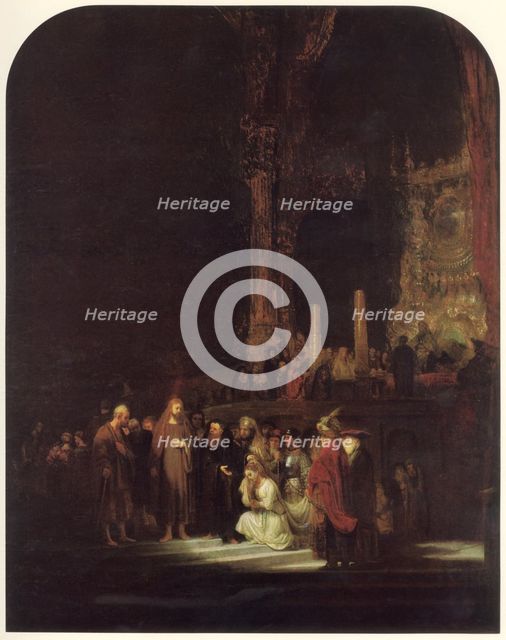
'The Woman Taken In Adultery', 1644, (1967). Creator: Rembrandt Harmensz van Rijn.
3-102-282 - The Print Collector/Heritage Images
'The Woman Taken In Adultery', 1644, (1967). Biblical scene in a temple: a weeping woman is on her knees before Christ - the central figures are bathed in light while the background fades into obscurity. The theme is sinning and the need for forgiveness. Members of the Jewish ruling council gather round. Afraid of Christ's popular preaching, they planned to trick him into transgressing the Jewish law. They said to him: 'Teacher, this woman has been caught in the act of adultery. Now in the law Moses commanded us to stone such women. What do you say about her?' This is the moment of decision that could entrap the young preacher. A man puts his finger to his lips as if hushing the crowd. Will Christ plead for mercy or will he uphold the law? It seems that either way, he will be condemned as well as the woman. Christ's reply became one of the most famous quotations in the history of Christianity: 'He that is without sin among you, let him first cast a stone at her.' The woman was released, the accusers confounded. Christ was free to preach again, but not without a parting word to the repentant woman: 'Go and sin no more.' Painting in the National Gallery, London. From "Rembrandt" by Ludwig Münz and Bob Haak, [Harry N. Abrams, Inc., New York, 1967]
Image Details
People Information
Creator
- Rembrandt Harmensz van Rijn, attributed to: Dutch: Artist, painter, printmaker
People Related
- Bob Haak: Dutch: art historian, writer, curator
- Ludwig Münz: Austrian: art historian, author, gallery director
- Harry N. Abrams: American: Publisher
Category Hierarchy
Locations & Buildings Places of Worship
Religion & Belief Christianity
Society & Culture Issues & Causes
Society & Culture Art & Literature
Digital Image Size
Pixel Dimensions (W x H) : 4713x5964
File Size : 82,349kb
Aliases
- 0580103293
- 3-102-282
- 3102282