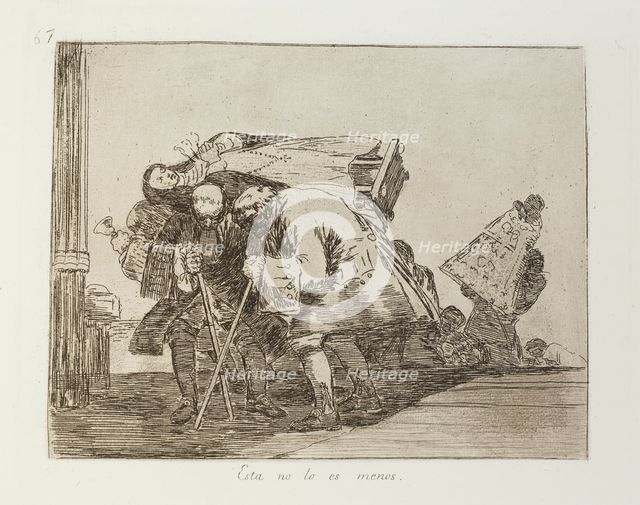
Esta no lo es menos.; Los Desastres de la Guerra, Madrid 1863. Creator: Francisco Goya.
3-101-577 - "Royal Academy of Arts, London"/Heritage Images
Esta no lo es menos, (This is not less so/This one is no less so), Plate 67, "Los Desastres de la Guerra", c1810, (published 1863). Several well-dressed figures, probably members of the nobility, carry an effigy of the Virgin on their shoulders. Behind them is a group of people carrying another religious image. These may be the Virgin of Solitude and the Virgin of Atocha. The scene may be a criticism on social class, well characterised by its somewhat old-fashioned clothing. Although Goya did not make known his intention when creating the plates (between 1810 and 1815), art historians see them as a visual protest against the violence of the 1808 Dos de Mayo Uprising, the subsequent cruel war that ended in Spanish victory in the Peninsular War of 1808-1814, and the setbacks to the liberal cause following the restoration of the Bourbon monarchy in 1814. The prints were not published until 35 years after Goya's death, probably because only then was it considered politically safe to do so. From "Los Desastres de la Guerra: colección de ochenta láminas inventadas y grabadas al agua fuerte por Don Francisco de Goya", (The Disasters of War: collection of eighty plates made and etched by Don Francisco de Goya), [Madrid, 1863].
Image Details
People Information
Creator
- Francisco Goya, attributed to: Spanish: Artist, painter and printmaker
People Related
- Laurenciano Potenciano: Spanish: Printer
Category Hierarchy
History & Politics War & Military Wars, Battles & Events
Religion & Belief Christianity
Society & Culture Issues & Causes
Artistic Representations Satires
Digital Image Size
Pixel Dimensions (W x H) : 4960x3914
File Size : 56,876kb
Aliases
- 15/4244
- PL012391
- 1210002652
- 15/4244
- 3-101-577
- 3101577