Soaking It Up: The Sponge Divers
25 November 2026

Before plastic, bathtime involved a hunt. A sponge is an animal, and the best ones lived on the seabed, so someone had to fetch them.
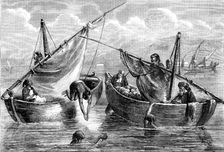
For centuries that meant a single breath. Off the Syrian coast in 1862, divers sank with heavy stones and hacked sponges from the rocks. It was dangerous work, and sometimes, on reaching the surface, the divers bled from their mouths, noses, eyes, and even ears. Kunisada II’s Japanese print shows the same breath-holding feats. Women divers, known as amas, could hold their breath for up to 3 minutes. The trade still exists in modern Japan and Korea.
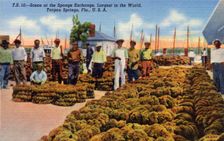
Greek divers brought diving suits to Tarpon Springs, Florida, in the early 1900s, and by 1940 the town was a sponge capital of the world. Air-fed helmets allowed deeper, longer dives, but they brought the bends: surface too fast and nitrogen bubbles form in the blood, which crippled or killed many divers.
Ashore, the catch was sorted and sold at the sponge exchange, then packed in warehouses like that of the Esfakis Brothers in Nassau, Bahamas. Our image from the colonial period shows Black women workers and a white overseer. Scientists took an interest too: marine biologist D. G. Lillie – a member of Scott’s expedition to Antarctica on the 'Terra Nova' - posed c1911 with siliceous sponges, which are glassy and no use in the bath.
Disease and synthetic sponges eventually sank the trade, though Tarpon Springs still harvests a few. Sponges found new fame in sporting events: at Laing’s 1988 Family Day, people pelted a man wobbling across a spinning balance beam over a water tank, in an It’s a Knockout contest. He got a soaking, which is what sponges are for.