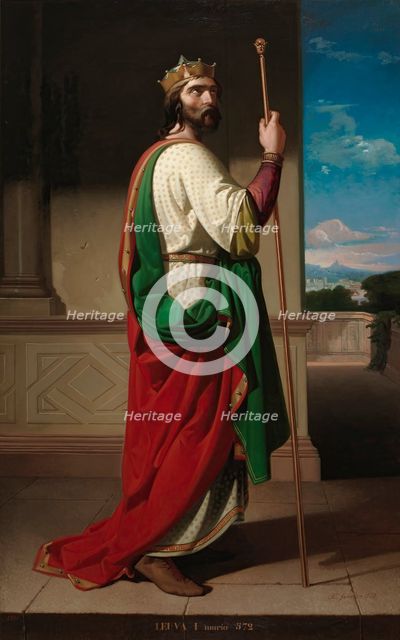
Liuva I, King of the Visigoths, 1855. Creator: Antonio Gisbert.
3-097-607 - Heritage Art/Heritage Images
Liuva I, King of the Visigoths, 1855. Imaginary portrait of Liuva I (died 573 AD/CE), Visigothic King of Hispania and Septimania (567-573) who succeeded Athanagild and preceded Leovigild. He wears a white tunic and a crimson mantle and rests his hand on a long sceptre. Liuva succeeded Athanagild, and before being proclaimed king in the city of Nabona, he had been Duke of Septimania. In order to avoid unnecessary conflicts, he associated his brother and successor Leovigild, Duke of Toledo, with the throne, delegating to him the government of Hispania while reserving for himself that of Gaul. In 1847, José de Madrazo, as director of the Royal Museum, planned to create a vast royal icon collection within the museum, encompassing the entire history of the Spanish Monarchy. This plan was finally formalized in a Royal Order signed by Isabella II on December 1, 1847. Beyond the desire to recover the nation's historical past, the project had a clear political purpose: to legitimize the sovereign's rights during a period characterized by a relentless struggle against female power.
Image Details
People Information
Creator
- Antonio Gisbert, attributed to: Spanish: Artist, painter
Subject
- Liuva I: Visigothic: king
Digital Image Size
Pixel Dimensions (W x H) : 3102x4960
File Size : 45,076kb
Aliases
- Q59856984
- GTR
- 1410000542
- 3-097-607
- 3097607
- Q59856984