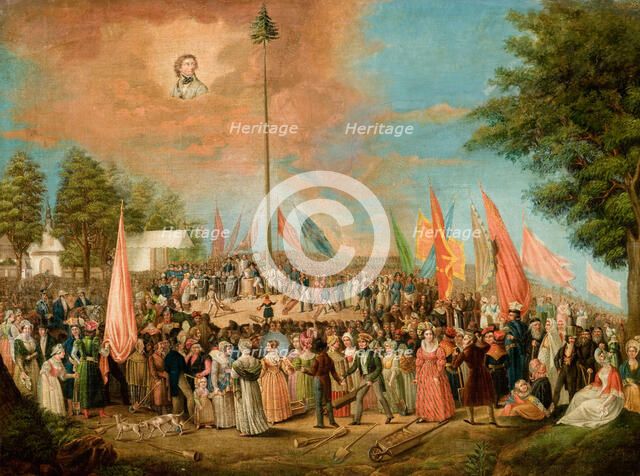
Raising of the Kosciuszko Mound, between 1838-1860. Creator: Jan Nepomucen Bizanski.
3-071-938 - Heritage Art/Heritage Images
Raising of the Kosciuszko Mound, between 1838-1860. The decision to commemorate Tadeusz Kosciuszko (1746-1817) with a monument worthy of his services to the homeland was made shortly after the news of the death of the Head of the Uprising in 1794. In the summer of 1820, the Senate of the Free City of Krakow passed a project to build a symbolic grave for Kosciuszko at Blessed Bronislawa Hill. In the centre of the composition, the artist marked a spruce set to determine the axis and radius of the grave and depicted the moment of consecration of the ground from the battlefields of the 1794 uprising. A crowd occupies the entire hill, which is to become the base of the Mound. The foreground is occupied by a group of several dozen people symbolizing the unification and involvement of the whole nation in the matter of the grave. There are women and men, young people, people in their prime, old men and children, nobility, peasants, townspeople, intellectuals, soldiers, Jews and monks, all well characterized by the artist in their cultural and social diversity. To the right of the painting, Bizanski distinguished two figures: a lady facing straight ahead, in front of whom a small wheelbarrow loaded with earth was placed, and a man in a brown coat facing her. These are opera singer Angelica Catalani and probably sculptor Bertel Thorvaldsen.
Image Details
People Information
Creator
- Jan Nepomucen Bizanski, attributed to: Polish: Artist, painter, professor
Subject
- Angelica Catalani: Italian: Opera singer
- Bertel Thorvaldsen: Danish: Artist, sculptor, restorer, collector
People Related
- Tadeusz Kosciuszko: Polish, Lithuanian, American: Soldier, general, leader
Category Hierarchy
History & Politics Politics Political Events
Artistic Representations Landscapes
Artistic Representations Allegories
Society & Culture Death & Burial
Digital Image Size
Pixel Dimensions (W x H) : 4000x2976
File Size : 34,875kb
Aliases
- MNK II-a-571
- E
- 1300000071
- 3-071-938
- 3071938
- MNK II-a-571