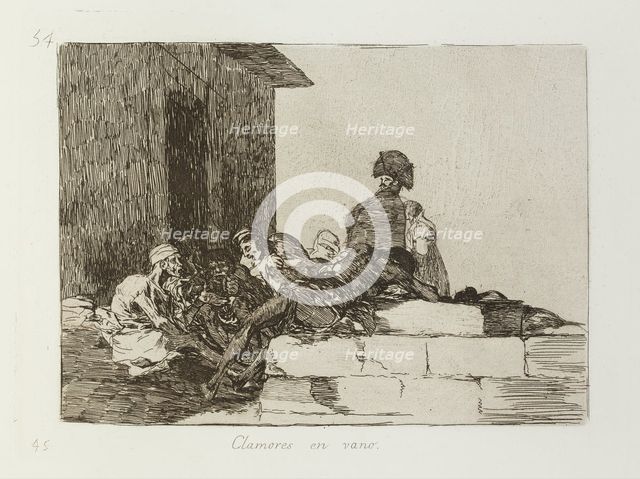
Clamores en vano.; Los Desastres de la Guerra, Madrid 1863. Creator: Francisco Goya.
3-101-567 - "Royal Academy of Arts, London"/Heritage Images
Clamores en vano, (Appeals are in vain), Plate 54, "Los Desastres de la Guerra", c1810, (published 1863). Famine: a group of people lie dying in agony near a house. Their skeletal bodies, emaciated arms and legs, and gaunt faces tell us they are victims of the famine that devastated many Spanish cities during the Spanish War of Independence. They have asked for help from a French officer in the company of a young woman, but the officer does not respond. Although Goya did not make known his intention when creating the plates (between 1810 and 1815), art historians see them as a visual protest against the violence of the 1808 Dos de Mayo Uprising, the subsequent cruel war that ended in Spanish victory in the Peninsular War of 1808-1814, and the setbacks to the liberal cause following the restoration of the Bourbon monarchy in 1814. The prints were not published until 35 years after Goya's death, probably because only then was it considered politically safe to produce a series of artworks criticising both the French and the restored Bourbons. From "Los Desastres de la Guerra: colección de ochenta láminas inventadas y grabadas al agua fuerte por Don Francisco de Goya", (The Disasters of War: collection of eighty plates made and etched by Don Francisco de Goya), [Madrid, 1863].
Image Details
People Information
Creator
- Francisco Goya, attributed to: Spanish: Artist, painter and printmaker
People Related
- Laurenciano Potenciano: Spanish: Printer
Category Hierarchy
History & Politics War & Military Wars, Battles & Events
Society & Culture Issues & Causes
Artistic Representations Satires
Society & Culture Wealth & Poverty
Society & Culture Death & Burial
History & Politics War & Military Military Figures & Personnel
Digital Image Size
Pixel Dimensions (W x H) : 4960x3714
File Size : 53,970kb
Aliases
- 15/4230
- PL012381
- 1210002642
- 15/4230
- 3-101-567
- 3101567