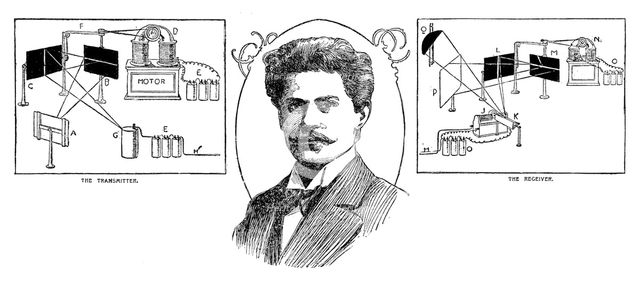
Jan Szczepanik and his marvellous invention, 1898. Creator: Unknown.
3-086-123 - The Print Collector/Heritage Images
Jan Szczepanik and his marvellous invention, 1898. 'Jan Szczepanik, the Transmitter, the Receiver. The Latest Triumph of Electricity. The Telelectroscope [an apparatus for distant reproduction of images and sound using electricity] is the latest triumph of the electrician's genius. Writing by electricity (the telegraph) is already a matter of ancient history; hearing by electricity (the telephone), if not yet perfect, has become indispensable; seeing by electricity (the telelectroscope) is to be the feat of the future. The invention has to be credited to a Galician schoolmaster, Herr Jan Szczepanik, and the experiments that have been made with it in Vienna have been most satisfactory. The mechanism of the actual apparatus is a profound secret, but the accompanying sketches illustrate the theory of the instrument.' The telectroscope or electroscope was the first conceptual model of a television or videophone system. The term was used in the 19th century to describe science-based systems of distant seeing. The name and its concept came into being not long after the telephone was patented in 1876, and its original concept evolved from that of remote facsimile reproductions onto paper, into the live viewing of remote images. From "Illustrated London News", 1898.
Image Details
Category Hierarchy
Science & Nature Technology & Innovation
Trade & Industry Communications
Artistic Representations Portraits
Digital Image Size
Pixel Dimensions (W x H) : 3892x1706
File Size : 6,485kb
Aliases
- ILN_1898_Page_533.jpg
- 1898
- 0580102757
- 3-086-123
- 3086123