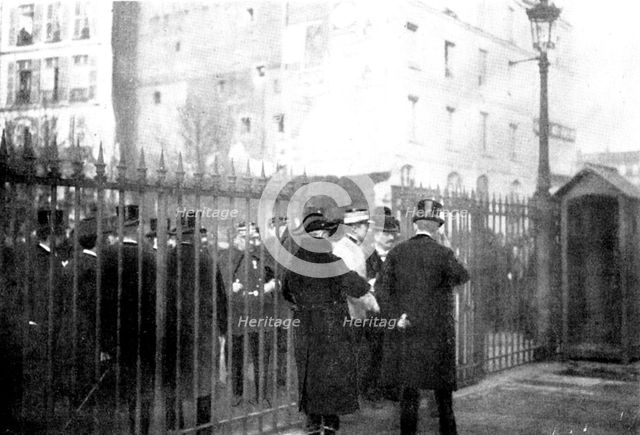
Trial of M. Zola in Paris: scenes at the Assize Court - arrival of Lieutenant-Colonel Picquart, 1898 Creator: Gribayedoff.
3-085-820 - The Print Collector/Heritage Images
Trial of M. Zola in Paris: scenes at the Assize Court - arrival of Lieutenant-Colonel Picquart, 1898. The "J'accuse" case. 'Suddenly their attitude changed again, and Colonel Picquart was sent to Tunis, while the friends of Esterhazy did their best to ruin him. That is the upshot of his evidence, and it has not been contradicted on any material point. As for Maître Demange, the counsel of Dreyfus, he cited M. Sulles, another advocate, as a witness who was prepared to swear that one of Dreyfus's judges admitted to him the part which was played by the secret document. On this mysterious paper, which was not shown to the prisoner or his counsel, the tribunal found Maître Demange's client guilty. M. Sulles presented himself to tell this story on behalf of M. Zola, but, significantly.., he was not allowed to speak. Moreover, the defence succeeded in smashing the testimony of the chief expert witness, M. Bertillon, who held Dreyfus to be the author of the bordereau. It is unlikely that any importance will ever be attached again to M. Bertillon's opinion of handwriting. The moral effect of the trial is greatly to strengthen the demand for a revision of the Dreyfus judgment; but this has now become a political, even a revolutionary, issue in France'. From "Illustrated London News", 1898.
Image Details
People Information
Creator
- Gribayedoff, attributed to: French: Photographer
Subject
- Georges Picquart: French: General
People Related
- Emile Zola: French: Author, writer, novelist
Category Hierarchy
Society & Culture Issues & Causes
History & Politics War & Military Military Figures & Personnel
Digital Image Size
Pixel Dimensions (W x H) : 2395x1627
File Size : 3,806kb
Aliases
- ILN_1898_Page_238_c.jpg
- 1898
- 0580102418
- 3-085-820
- 3085820