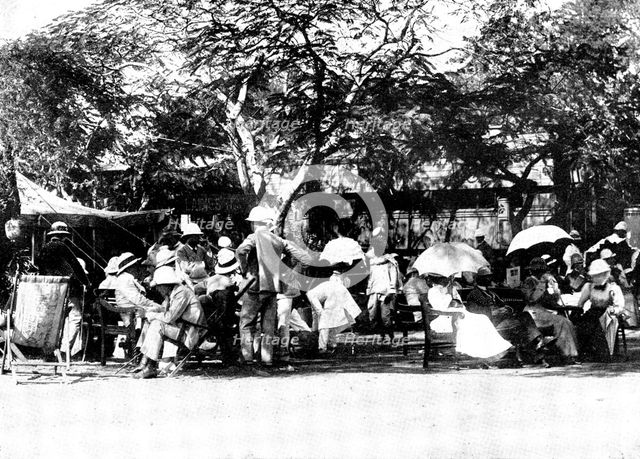
The Total Eclipse of the Sun: group...at the railway siding, Jeur, on the day of the eclipse, 1898. Creator: Stewart.
3-085-813 - The Print Collector/Heritage Images
The Total Eclipse of the Sun: group taken at the railway siding, Jeur, on the day of the eclipse, 1898. [View] at Jeur, in the Sholapur district, where a number of experts encamped for its observations...Totality lasted 2 min. 10 sec. Shade temperature fell from 82 deg. Fahr. to 77 deg. The darkness was much less than was expected...The sky assumed a leaden hue, but only a few planets and stars were visible to ordinary vision...One of the most curious results of the observations has been the use of the kine-matograph for recording the progress of the eclipse. The instrument, supplied by the ingenious Mr. Maskelyne, of Egyptian Hall fame, was worked at Buxar by the Rev. J. M. Bacon, and at Viziadrug by Lord Graham. The observers owe their success, first, to the splendid atmospheric conditions of the Indian sky at this, the most delightful season of the year, and also to the services afforded them by the [British] Indian Government. For instance, the chief officials of Hyderabad went to Talni and caused the most stringent precautions to be taken so that the observers should not be disturbed while performing their delicate task...The natives seem to have been very interested in the arrangements for making the observations'. From "Illustrated London News", 1898.
Image Details
People Information
Creator
- Stewart, attributed to: British: photographer
Subject
- Arthur Havelock: British: colonial administrator, governor
Category Hierarchy
Science & Nature Weather & Seasons
Science & Nature Technology & Innovation
Science & Nature Natural Phenomena
Digital Image Size
Pixel Dimensions (W x H) : 2393x1716
File Size : 4,011kb
Aliases
- ILN_1898_Page_234_c.jpg
- 1898
- 0580102410
- 3-085-813
- 3085813