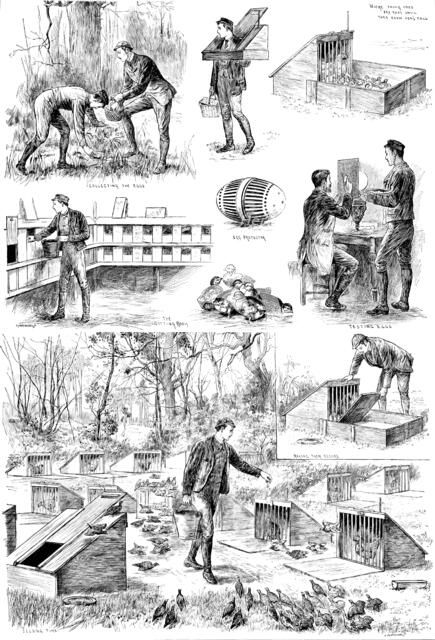
Rearing Pheasants: sketches at the Duke of Norfolk’s Pheasantry at Angmering Park, Sussex, 1890. Creator: Carl Hentschel.
3-078-006 - The Print Collector/Heritage Images
Rearing Pheasants: sketches at the Duke of Norfolk's Pheasantry at Angmering Park, Sussex, 1890. 'Collecting the eggs; where the young ones are kept until they know hen's call; making them secure; the sitting room; egg protector; testing eggs; feeding time. The rearing of pheasants...is conducted in a systematic manner, and at much private cost, by many landed proprietors. Pheasant-eggs...are procured and hatched usually by poultry hens...The hatching process, which may occupy twenty-two or twenty-four days, is carefully superintended...the young pheasant chicks, with the hen, are brought out into the run, and are kept a few days under the coop, fed by the gamekeeper, to whose call they readily come, until they grow strong enough to be removed to the covert...for medicinal purposes, a dose of sulphate of iron is put into [their] water...Our Illustrations...show the collecting of pheasant-eggs in the covert; the close rows of boxes in which they are placed with hens to sit on them; and the way in which they are examined, by inspecting them under a strong light, to test the progress of hatching; also the coops and enclosures for the chickens, with partitions removable, at the proper time, to release them from the hen's stepmotherly care'. From "Illustrated London News", 1890.
Image Details
People Information
Creator
- Carl Hentschel, attributed to: British, Polish: artist, photographer, printmaker, illustrator, inventor and businessperson
People Related
- Henry Fitzalan-Howard, 15th Duke of Norfolk: British: politician, philanthropist
Digital Image Size
Pixel Dimensions (W x H) : 3760x5538
File Size : 20,335kb
Aliases
- ILN_1890_Page_500.jpg
- 1890
- 0580100475
- 3-078-006
- 3078006