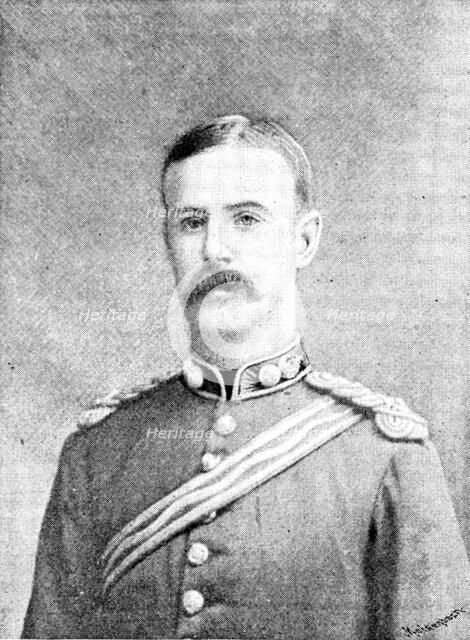
Lieutenant W. E. Stairs, R.E., second in command of Mr. Stanley’s African expedition, 1890. Creator: Unknown.
3-077-643 - The Print Collector/Heritage Images
Lieutenant W. E. Stairs, R.E., second in command of Mr. Stanley's African expedition, 1890. Portrait from a photograph by Mr. Valery. 'Mr. Stanley...bears testimony to the intelligence and ability of Lieutenant Stairs, who also seems to have had to do a good deal of the fighting with hostile native tribes. On Aug. 13, 1887, the natives attacked the camp in a resolute and determined fashion. Their stores of poisoned arrows, they thought, gave them every advantage; and, indeed, when the poison is fresh it is most deadly. Lieutenant Stairs and five men were wounded by these arrows; but Lieutenant Stairs' wound, just below the heart, was from an arrow the poison of which was dry - it must have been put on some days before. After three weeks or so he recovered strength, though the wound was not closed for months...There was much curiosity to know what this poison might be, and...someone...found several packets of dried red ants, or pismires. It was then discovered that the dried bodies of these, and of still more venomous insects, caterpillars, and spiders, ground into powder, cooked in palm oil, and smeared over the wooden points of the arrows, made the poisons by which not only men but the largest animals can be killed with terrible sufferings.' From "Illustrated London News", 1890.
Image Details
People Information
Creator
- Unknown, attributed to: :
After
- Valéry: : Photographer
Subject
- William Grant Stairs: Canadian-British: explorer, soldier, and adventurer
People Related
- Sir Henry Morton Stanley: British, American: Explorer, journalist, soldier, colonial administrator, author and politician
- Joseph Conrad: Polish, British: Writer, author, master mariner
Category Hierarchy
Society & Culture Issues & Causes
Artistic Representations Portraits
Society & Culture Sickness & Disease
History & Politics War & Military Military Figures & Personnel
Digital Image Size
Pixel Dimensions (W x H) : 1151x1567
File Size : 1,762kb
Aliases
- ILN_1890_Page_155.jpg
- 1890
- 0580100039
- 3-077-643
- 3077643