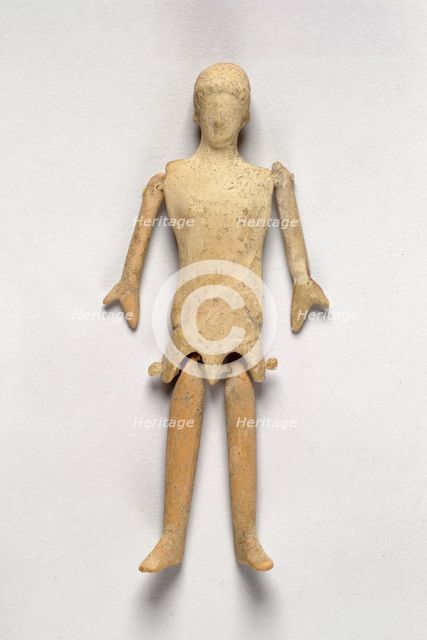
Doll, 5th century BC. Creator: Unknown.
3-047-580 - Heritage Art/Heritage Images
Doll, 5th century BC. Additional Info: Dolls were common throughout the ancient Mediterranean world. In the 500s BC, Greek artisans began to produce a distinctive form of terracotta doll with separately-made arms and legs, which were attached with string. Unlike today's baby-dolls, these dolls always represent adult women. They have short tunics painted on their torso and this example retains traces of red paint. This doll has simple mitten-shaped hands, but many others carry krotala or castanet-like instruments. Jointed terracotta dolls like this one have been found in children's graves and in religious sanctuaries. Ancient writers suggest that, just before their marriage, girls would dedicate dolls and other toys to various goddesses. Some scholars, however, think that these terracotta dolls were not the toys referred to in literary sources. They think that their primary purpose was religious. The dolls would have been hung as charms, with the movement and noise of their swinging arms and legs meant to scare off evil spirits. Their placement in graves and sanctuaries would have been connected with this protective role.
Image Details
Digital Image Size
Pixel Dimensions (W x H) : 3052x4578
File Size : 40,934kb
Aliases
- 74.AD.46
- 103SZQ
- 1200009488
- 3-047-580
- 3047580
- 74.AD.46