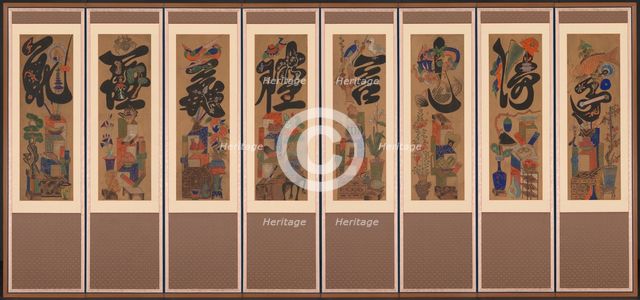
Munja-Chaekgeori Screen (Character-Books Screen), late 1800s. Creator: Unknown.
2-748-712 - Heritage Art/Heritage Images
Munja-Chaekgeori Screen (Character-Books Screen), late 1800s. During the late 1800s in Korea, local and central governments actively promoted Confucian teachings in fear of the influx of foreign ideas and beliefs like Christianity. Under the patronage of such leadership, many types of munjado (literally meaning "characters") screens were produced. Such paintings adorned Korean aristocrats’ studies as well as the classrooms of Confucian academies. The eight Korean characters inscribed on the upper portion of each panel of this screen refer to the values of Confucian teachings of the Joseon dynasty: filial piety ( hyo ), brotherly love ( je ), loyalty ( chung ), trust ( sin ), propriety ( yae ), righteousness or justice ( eui ), modesty or integrity ( yeom ), and humility or the feeling of shame ( chi ). The lower section of each panel depicts the imagery of books, scholarly utensils, and luxurious objects called chaekgeori (loosely translated as "book and things"), another pictorial genre popular in late 19th-century Korea, a period when both aristocrats and the newly rich were passionately devoted to amassing books and antiquities. Primarily distinctive to the Ganwon province located in northeast Korea, this munja-chaekgeori screen is not only an extremely rare type in which two independent pictorial genres are harmoniously married, but it is also a work that exemplifies the playful nature of Korean art.
Image Details
Digital Image Size
Pixel Dimensions (W x H) : 16879x7907
File Size : 391,003kb
Aliases
- 2017.6
- 294203
- 0940026728
- 2-748-712
- 2017.6
- 2748712